The "Desk-Job Drain": Why Thinking Exhausts Your Body Battery
You check your fitness tracker at 3 PM.
Steps taken: 2,100. Body Battery: 40%. Stress Level: High.
You haven't run a marathon. You’ve just been sitting in a chair, staring at a screen, answering emails, and jumping between Zoom calls. Yet, you feel completely wiped out. The "Brain Fog" is thick, and you can't focus on complex tasks anymore.
Welcome to the "Desk-Job Drain."
Many high-performers believe that if they aren't moving physically, they aren't spending energy. Biology says otherwise. Your brain accounts for only about 2% of your body weight, but it consumes 20% of your body's total energy (glucose and ATP) [1].
When you force your brain into states of high cognitive load without the right neuro-nutritional support, it physically exhausts your entire body. Here is why it happens, and the specific protocol to fix it.
Blocker 1: The Cost of "Context-Switching"
You rarely do one thing at a time. You write a report, check a Slack message, answer a call, and go back to the report.
Neurologically, this is called "Context-Switching." Every time you shift your attention between tasks, your brain burns a significant amount of metabolic energy to refocus. Studies show that prolonged mental fatigue and cognitive load directly impair physical performance and drain your systemic energy [2]. This constant shifting triggers a low-grade stress response. Your tracker registers this as a High Stress Score, draining your daily energy reserves before the workday is even over.
Blocker 2: Neuro-Inflammation (The Real "Brain Fog")
Brain fog isn't just a feeling; it is a physiological state. Chronic stress, poor sleep, and excessive screen time can lead to mild neuro-inflammation.
When your neurons are fatigued, the communication between them slows down. You experience this as forgetting a word, losing your train of thought, or lacking the willpower to tackle hard tasks.
The Solution: Neuroplasticity and Lion's Mane
Caffeine won't fix this. Caffeine just masks the fatigue by increasing cortisol. To actually repair the cognitive pathways and sustain focus, you need to support the brain's physical structure.
This is why top-tier executives and biohackers use Lion’s Mane (Hericium erinaceus).
The Science of NGF (Nerve Growth Factor): Lion's Mane is unique in the natural world because it contains specific bioactive compounds (Hericenones and Erinacines) that can cross the blood-brain barrier.
Once in the brain, they stimulate the production of NGF (Nerve Growth Factor) [3]. NGF is a protein that acts like "fertilizer" for your brain. It helps maintain existing neurons and stimulates the growth of new neural connections (neuroplasticity), which is directly linked to improved cognitive function [4].
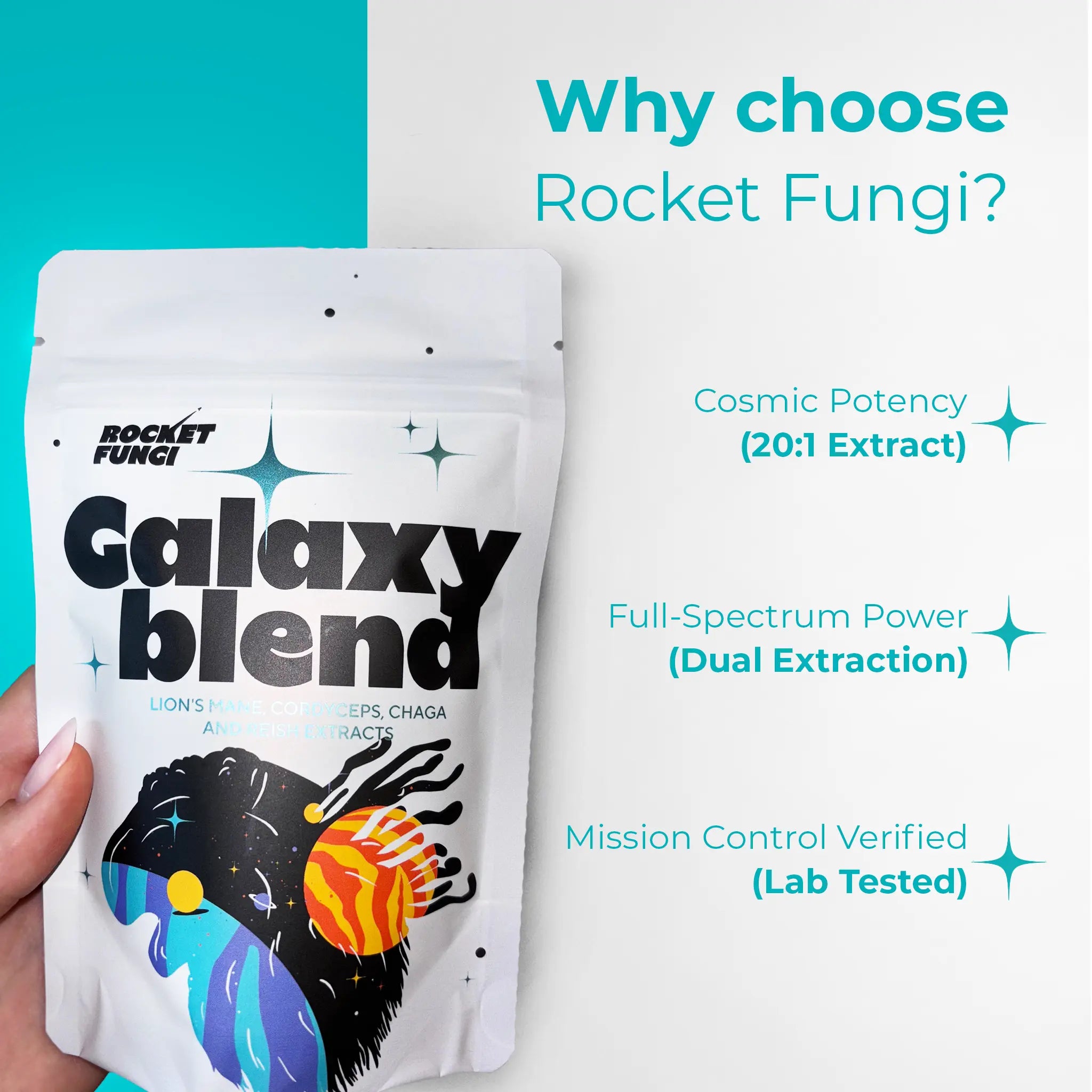
Why Rocket Fungi Lion's Mane Works: You can't just eat raw mushrooms and expect results. The active compounds are locked behind tough cellular walls (chitin). We use a highly concentrated extract focusing purely on the fruiting body.
-
The Dose: 3 capsules deliver 1260mg of premium Lion's Mane extract, standardized for maximum potency.
The "Deep Work" Protocol
If you want to protect your Body Battery and eliminate Brain Fog, treat your cognitive work like an athletic event.
1. The 90-Minute Rule: Human focus operates in Ultradian Rhythms (90-minute cycles). Do not try to focus for 4 hours straight. Work intensely for 90 minutes, then take a 15-minute complete neurological break (no screens).
2. The Pre-Focus Fuel: Take 3 capsules of Rocket Fungi Lion's Mane roughly 30 to 45 minutes before your most demanding "Deep Work" session of the day.
The Data Shift: Users who combine Lion's Mane with structured deep work blocks report feeling less "fried" at the end of the day, with lower daytime stress metrics on their wearables.
Stop burning out your brain. Start fueling your focus.
References:
-
Raichle, M. E., & Gusnard, D. A. (2002). Appraising the brain's energy budget. Proceedings of the National Academy of Sciences.
-
Marcora, S. M., Staiano, W., & Manning, V. (2009). Mental fatigue impairs physical performance in humans. Journal of Applied Physiology.
-
Lai, P. L., et al. (2013). Neurotrophic properties of the Lion's mane medicinal mushroom... International Journal of Medicinal Mushrooms.
-
Mori, K., et al. (2009). Improving effects of the mushroom Yamabushitake (Hericium erinaceus) on mild cognitive impairment: a double-blind placebo-controlled clinical trial. Phytotherapy Research.